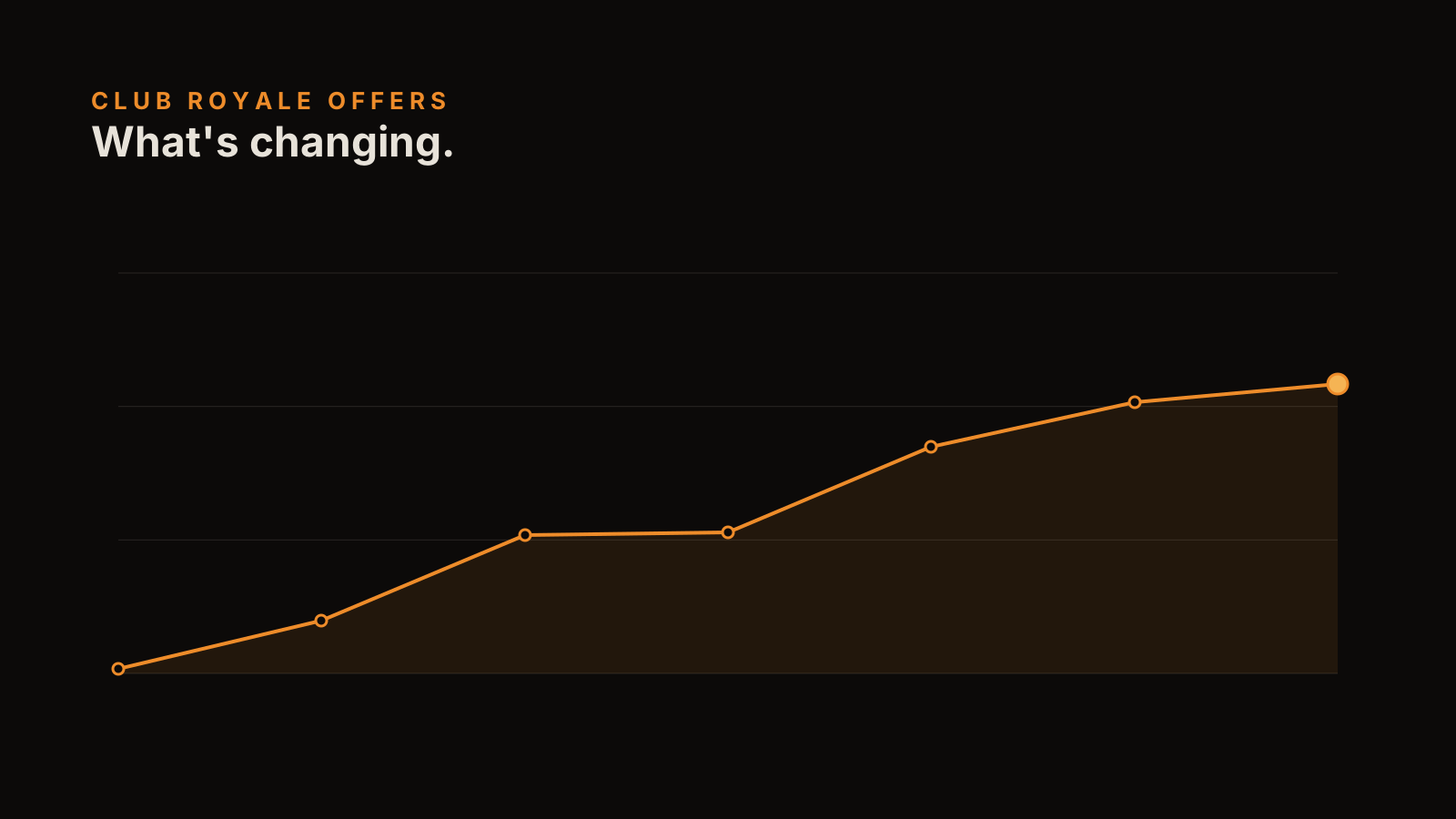
One quiet sailing can reset your Club Royale offer ceiling.
The sailing you weren't going to play anyway
Boarding day on a family sailing. Two kids, a beach day already booked in Nassau, and a week where you'll sit down at a machine maybe twice, mostly because the pool deck got rained out.
SailQuery
Which cruise produced which offer?
If that question takes you more than ten seconds to answer, the per-cruise model is already costing you something.
That week doesn't feel like a decision. It feels like a cruise you took for reasons that had nothing to do with the casino, backed by three prior sailings of real play and offers that have been landing on schedule since.
Then the next offer email arrives and it's a notch below where it should be. Not a small variance. A different category of offer than the one you'd been planning next spring around.
Most players read that as the program tightening up. It usually isn't. The sailing you barely played is the one Club Royale looked at hardest, and it did exactly what it was designed to do.
The last-cruise ceiling
Call it the last-cruise ceiling. Club Royale evaluates play per cruise rather than as a rolling annual average, so the sailing you just finished sets the top of what your next offer can be. Earlier cruises don't average in to cushion it.
That distinction sounds academic right up until you map it onto how people actually cruise. Under an averaging model, a quiet week is diluted, a rounding error against a strong year. Under per-cruise evaluation, a quiet week is the current reading, and the current reading is what generates the next offer.
So the damage isn't a slowdown in the pipeline. It's a reset of the ceiling, and the ceiling was the thing you were quietly counting on when you assumed the next comped balcony was more or less locked.
The ceiling is recoverable. But it recovers the same way it dropped: one cruise at a time.
Why the rolling-average assumption sticks
Nobody arrives at the averaging assumption by accident. It's how nearly every other loyalty structure a cruiser touches behaves, and it's how tier accumulation itself behaves, so it's a reasonable thing to carry over.
And the program's own communication doesn't correct it. Offer emails don't tell you which sailing generated them. There's no line item, no "based on your April cruise," no attribution at all. You get an offer, and if it's lower than the last one, the cause is invisible.
That invisibility is what turns a mechanical outcome into a mystery. Players compare the new offer against their overall play history, find no explanation there, and conclude the program changed. The history isn't what got read.
What's actually on the record
The primary anchor here is a Royal Caribbean Blog message-board thread (topic/26225) in which Royal Caribbean staff describe Club Royale offer evaluation as running per cruise rather than as a rolling annual figure. The exact wording and who posted it aren't something we can pin down with confidence, but the substance of the claim, that offers reset with each sailing instead of accumulating over a year, holds up.
Players on r/royalcaribbean have independently landed in the same place, describing offers that track the most recent sailing rather than a season of play. Thread 'May '26 & June '26 Club Royale On-Board Offers' states earning 2,500 points in a year (Apr 1–Mar 31) across cruises grants a free cruise, indicating rolling-annual evaluation. ([source](https://www.reddit.com/r/royalcaribbean/comments/1tjqwnc/may_26_june_26_club_royale_onboard_offers/))
What isn't on the record matters just as much. Royal Caribbean has never published how a sailing is scored, what the thresholds are, or how much any single variable moves an offer. Anyone handing you a formula built one.
On the practical read of what typically lands after a light sailing versus a strong one, the honest answer is that we don't have a verified dataset to point to here. Player threads describe a general pattern where weaker play tends to soften the next offer and strong play tends to improve it, but nobody outside Royal Caribbean has the numbers to say by how much, in what category, or how fast the email shows up. Treat any specific claim on that front with suspicion until it's sourced.
Three sailings, one repricing
Run it forward with three cruises in a year.
Sailing one, a seven-night Caribbean you played hard. The offer that follows is the best you've had, and it's the one that shapes your expectations for everything after.
Sailing two, booked off that offer, played at roughly the same level. The pipeline confirms itself. At this point you've built a mental baseline: this is what my offers look like now.
Sailing three is the family week. Kids, port days, an hour at a machine on the sea day. You're not thinking about the casino at all, and there's no reason you should be, because in an averaging world this cruise is a rounding error against two strong ones.
The offer that follows sailing three doesn't reference sailing one. It reads sailing three.
And here's where players lose real money: the instinct is to book off that lower offer and play harder to fix it. That works, but it means paying more for a worse cabin than you would have gotten by putting the family week after a strong sailing you'd already banked an offer from, and booking the recovery cruise on the older offer while it was still live.
What changes if you plan around the ceiling
Sequencing becomes a lever you actually control.
If every sailing gets read on its own, then the order you take your cruises in matters as much as how much you play across the year. A low-play week costs you least when there's a strong sailing behind it and a booked cruise already locked in front of it, made on an offer generated before the quiet week landed.
Offer expiry stops being paperwork and starts being timing. The window on a live offer is the window in which the old ceiling still exists. Once it lapses, you're negotiating from whatever your last sailing said about you.
And the reflex to chase, adding play mid-cruise to salvage a week that was never going to be a casino week, gets weaker under this model, because the next sailing is a clean read regardless. You don't have to fix this cruise. You have to know which cruise is next and go in deliberately.
None of that requires a formula. It requires knowing which sailing produced which offer, which is precisely the thing the offer email never tells you.
Your offer history is the only ledger there is
Royal Caribbean doesn't hand you an audit trail. There's no screen showing you offer, sailing, and outcome lined up, which is why almost every serious Club Royale player ends up maintaining some version of a spreadsheet, a screenshots folder, or a starred email thread.
Those break in the same place. Screenshots don't sort. Emails don't compare side by side. And a spreadsheet you update from memory two weeks after a cruise loses exactly the detail the per-cruise model makes load-bearing: which sailing came before which offer, and what the terms and expiry actually were.
SailQuery exists for that one job. Capture an offer as it arrives, keep the whole set in one dashboard, compare them side by side, and see the expiry before the window closes rather than after. The Chrome extension reads what's already in front of you and keeps the data in your browser, not on anybody's server. One price, once.
What we're tracking next: whether the recovery side of the ceiling is symmetric, meaning whether one strong sailing after a quiet one restores the prior offer band or whether it takes two. Player reports point both ways right now, and that's a question worth answering with a real dataset rather than another forum argument.
SailQuery
See all your offers in one place
SailQuery captures every Club Royale offer from your account and compiles them into one searchable dashboard. First sync is free.