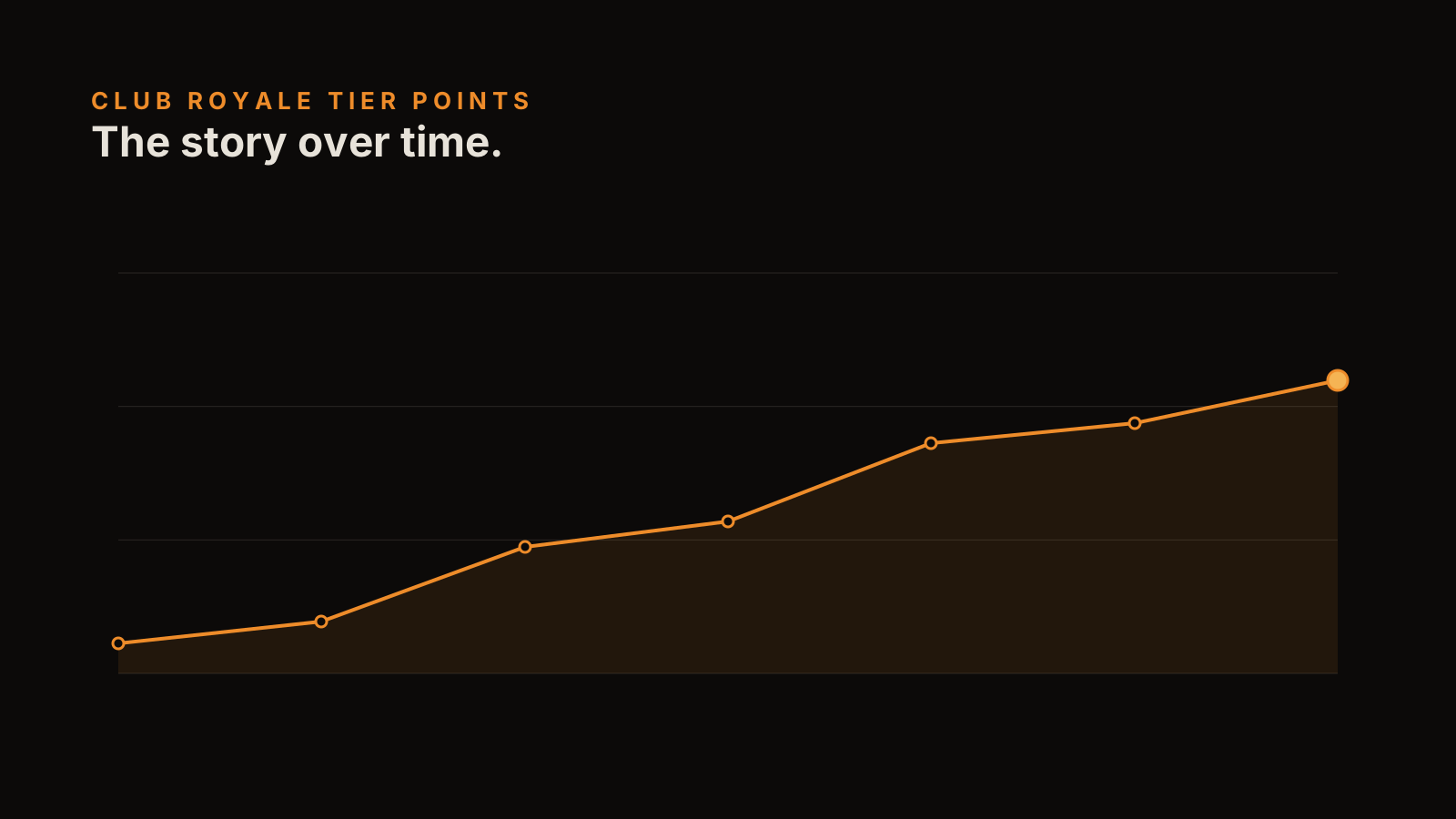
Table games earn one Club Royale tier point per $25, slots one per $5.
Five hundred dollars, twice, two very different point totals
Five hundred dollars wagered at a blackjack table on Symphony earns 20 Club Royale tier points. Five hundred dollars cycled through a slot machine one deck up earns 100.
SailQuery
Two earn rates, one dashboard
SailQuery keeps your Club Royale offers and point totals side by side across sailings, in your browser.
Same sailing, same casino, same money crossing the same company's floor. Five times the tier credit for the player who never sat down.
The rate is published: 1 tier point per $25 wagered on table games, 1 tier point per $5 on slots. It lives in Royal Caribbean's Club Royale FAQ and effectively nowhere else. It isn't printed on the felt. The pit doesn't mention it when they take your SeaPass card. And the tier screen in the app shows you a running total, never the rate that produced it.
The five-to-one felt gap
Call it the five-to-one felt gap. Every dollar a table player pushes across the layout carries one fifth the tier weight of a dollar spun through a machine, and that ratio holds at every stake, on every ship, for every game the pit rates by wagering.
That isn't a penalty for playing tables. It's the program pricing your action by how much the house expects to keep, and blackjack played reasonably well gives up a fraction of what a slot hold does over the same money. The logic is defensible.
The damage happens downstream. Players build a whole cruise season around a tier target, book the sailings, plan the sea days, and never once convert that target into the wagering it takes at the rate their game actually earns. The target is in points. The play is in dollars. The exchange rate between them is the thing nobody checked.
Why "the tables are where the real players are" gets this backwards
Walk any RC casino and the assumption is visible in the room. The pit is where the serious money sits, so the pit must be where the standing accrues. Forum threads reinforce it constantly: somebody reports a strong offer after a heavy blackjack week, and the thread reads it as evidence that table play carries more weight with the host.
Those offers track volume. Dollars wagered, at a rate that takes five times as many of them through the pit to reach the same number.
So a player who puts real money at risk at a $25 table across seven nights can finish a sailing behind a retiree who never bet more than a dollar a spin. Both of them walk off the ship with a number in the app. One of them knows why the number landed where it did.
What Royal Caribbean actually publishes
The two earn rates come from RC's own Club Royale FAQ, which is the only place the differential is stated plainly. It is not announced onboard, not posted at the table, and not surfaced next to your tier total in the app.
The reverse-engineering happened in public instead. Cruise Critic thread 2552833, "Club Royale revealed: how points are calculated," is where players assembled the mechanic from the terms and their own statements, and an RCBlog explainer covers the same ground for a wider audience.
One detail deserves pinning down before anyone runs their own numbers: what "wagered" means at a table. Machine play is coin-in, which is unambiguous. Table play is rated by the pit, and exactly how that rating translates into a wagered figure isn't something RC spells out in public terms, so the honest move is to ask your casino host directly before betting real money on the math. Play uncarded and the question is moot, because the pit rated nothing.
Run your own tier target through both rates
Pick the point total you're chasing and divide. That's the whole method, and it takes about fifteen seconds, which is roughly fifteen seconds longer than most players have ever spent on it.
Work an example. Say you're 4,000 points short. On slots that's $20,000 of coin-in, which sounds enormous until you remember that coin-in recycles: the same $500 bankroll spun and re-spun hits that figure without $20,000 ever leaving your bank account. On tables that same 4,000 points is $100,000 of rated wagering. Spread across two seven-night sailings, you're looking at roughly $7,100 of action per night.
Per hour, the picture shifts again. A $50 average bet at about 60 hands an hour puts $3,000 of action on the table, which is 120 tier points. A dollar-a-spin player at about 600 spins an hour cycles $600 of coin-in, which is also 120 tier points (Blackjack averages 70 hands per hour, and roulette averages 38 spins per hour, per Wizard of Odds house edge comparison table ([source](https://wizardofodds.com/gambling/house-edge/))). Fifty dollars a hand to match a dollar slot. Below roughly that average bet, the felt is quietly losing the pace race, no matter how much heavier the session feels.
Where the gap compounds: pace, not the badge
Royal Caribbean doesn't publish how offers get generated, and anybody who claims to know the formula is guessing. What players report consistently across years of threads is that the offers track how you played, not just where you landed. Density matters. Two thousand points earned over four nights reads differently than two thousand points earned over fourteen (Cruise Critic thread reports casinos required an average of 4 hours of play per day for comp qualification ([source](https://boards.cruisecritic.com/topic/2109995-casino-quotcompquot-questions/))).
That's where the rate gap stops being trivia and starts costing money. A table player generating fewer rated dollars per hour books a lower per-day pace, sailing after sailing, and the offers that come back reflect it. The player is spending real money at a low-edge game and receiving comp calibrated to a pace they didn't know they were setting.
Multiply that across a year of cruising and the gap isn't a tier badge. It's the balcony you didn't get offered.
Track the rate, not just the total
Almost nobody has this data assembled. The offers arrive by email and get starred. Point totals live in the app, visible for one sailing at a time, and disappear into next quarter. The spreadsheet that was going to fix it has four tabs and hasn't been updated since the last Oasis-class booking.
So the pace question, the one that actually drives what shows up in your inbox, gets answered in hindsight or not at all.
SailQuery keeps every offer, sail-by date, and point total from every sailing side by side in one dashboard, which is what makes a per-night pace visible while there's still a sailing left to change it. The extension runs in your browser and the data stays there. Nothing about your play sits on somebody else's server.
The rate is fixed. Whether you know what it's doing to your pace is not.
SailQuery
See all your offers in one place
SailQuery captures every Club Royale offer from your account and compiles them into one searchable dashboard. First sync is free.